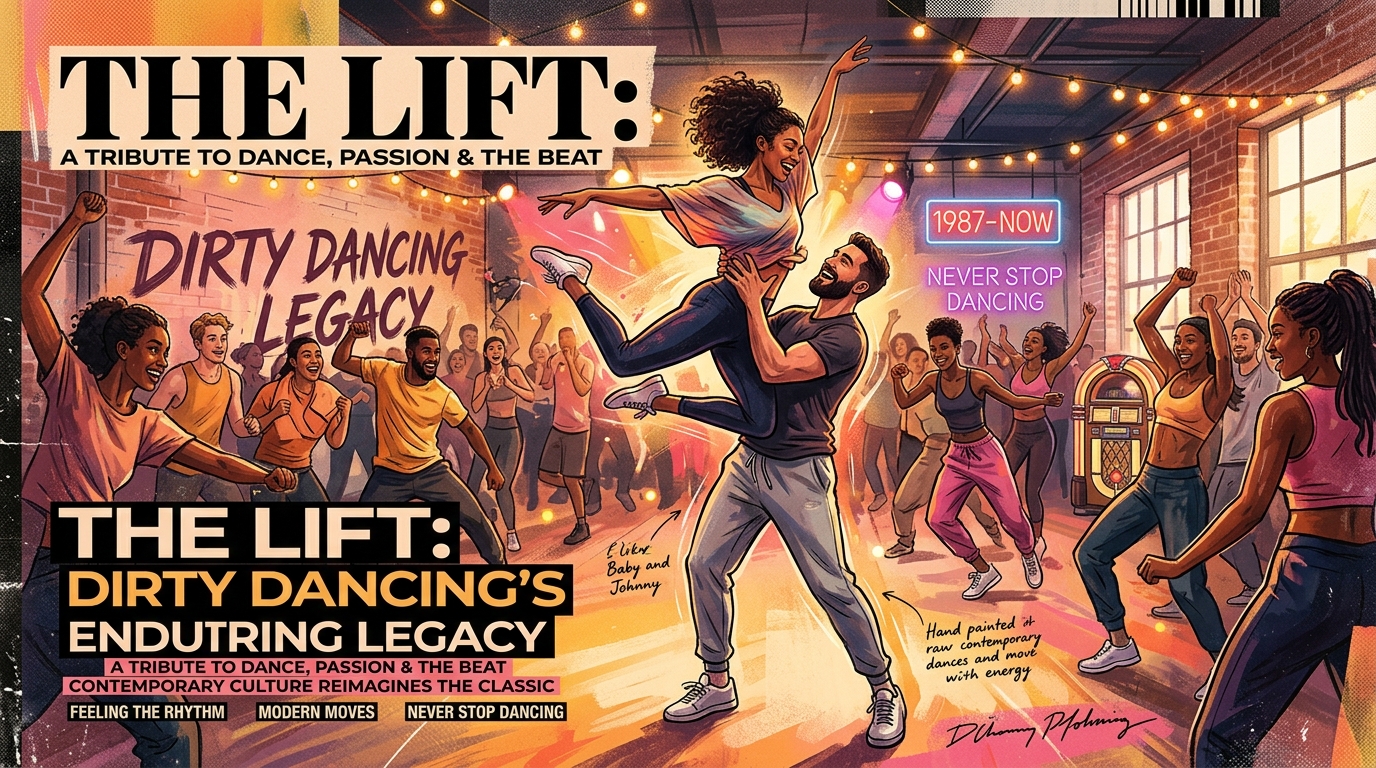
"Nobody puts Baby in a corner." With those seven words, spoken with conviction and a hint of defiance, Johnny Castle became more than a dance instructor—he became a symbol of standing up for yourself, for believing in someone even when they don't believe in themselves.
The Summer Everything Changed
The summer of 1987 was a simpler time. No smartphones, no social media, no streaming services. If you wanted to see a movie, you went to the theater. And in the summer of 1987, everyone went to see Dirty Dancing.
The film had modest expectations. It was made on a budget of just $6 million—tiny even by 1987 standards. The stars, Patrick Swayze and Jennifer Grey, were known but not famous. The director, Emile Ardolino, had never made a feature film. The script, by Eleanor Bergstein, was personal but unproven.
But something happened during production—a kind of magic that can't be manufactured. The chemistry between Swayze and Grey was electric. The dancing was authentic, passionate, raw. The story, about a young woman coming of age in the summer of 1963, resonated in ways no one predicted.
When Dirty Dancing opened in August 1987, it was a modest hit. But then came the word of mouth. People saw it, then told their friends to see it. They went back for second viewings, third viewings. The soundtrack, featuring "(I've Had) The Time of My Life," "Hungry Eyes," and "She's Like the Wind," dominated the radio. By the end of the year, Dirty Dancing wasn't just a hit—it was a phenomenon.
The Story Behind the Story
Eleanor Bergstein, who wrote the screenplay, drew from her own experiences. As a teenager in the 1960s, she had spent summers in the Catskills with her family—vacation resorts where families from the city would escape the heat. She was a "Baby," a nickname her father gave her. She saw the world of the dance instructors, the wait staff, the entertainment—separate from the guests but integral to the resort's life.
Bergstein was also a dancer. She understood the discipline, the passion, the physical toll of dancing at a professional level. She wanted to capture that world authentically—not the sanitized version usually seen in movies, but the real thing: sweaty, exhausting, exhilarating.
The character of Penny, the dancer whose unwanted pregnancy drives much of the plot, was based on a real person Bergstein knew—a dancer who faced that exact choice in the pre-Roe v. Wade era. The subplot wasn't just drama; it was social commentary, a reminder of what women faced before reproductive rights were legally protected.
Bergstein fought to keep the film authentic. Studio executives wanted to change the ending, to make it more conventional. They wanted to cast bigger names. But Bergstein and director Emile Ardolino stood their ground. They believed in the story, in the chemistry, in the magic they were capturing.
Casting Johnny and Baby
Finding the right actors for Johnny and Baby was crucial. The chemistry had to be undeniable—the kind that makes audiences believe two people could fall in love in the span of a summer.
Patrick Swayze: The Unexpected Star
Patrick Swayze was not the studio's first choice for Johnny. He was known, primarily for his role in The Outsiders (1983) and the television miniseries North and South, but he wasn't a movie star. He was a dancer, trained in ballet and jazz, which gave him an authenticity other actors lacked—but studios were skeptical about his leading man potential.
Swayze, however, understood Johnny. He came from a dance background—his mother was a choreographer, his father owned a dance studio. He knew the discipline, the physical demands, the emotional vulnerability required to be a dancer. He brought that understanding to the role.
What made Swayze's performance special was the combination of toughness and tenderness. Johnny could be brooding, guarded, reluctant to let anyone in. But when he did—when he let Baby see the real him—he was gentle, patient, kind. Swayze balanced these aspects perfectly, creating a character who felt real, layered, worth caring about.
The physical demands of the role were immense. Swayze performed most of his own dancing, and the training was grueling. But he never complained. He wanted to honor the dance community, to show the world what dancers really do.
Jennifer Grey: Finding Her Voice
Jennifer Grey had a famous father—Joel Grey, the Tony-winning star of Cabaret—but she was determined to make it on her own terms. She had appeared in Ferris Bueller's Day Off (1986) as Jeannie, the girl obsessed with Ferris, but it was a supporting role. Dirty Dancing was her first lead.
Grey wasn't a dancer. She had some training, but nothing close to what the role required. The training process was intense—months of daily dance classes, learning everything from basic steps to the complex routines that would become iconic.
What Grey brought to Baby was vulnerability. She wasn't playing a character—she was living through an experience. The awkwardness of early scenes, where Baby tries to learn the mambo and fails spectacularly, wasn't acting. Grey really was struggling, and that authenticity made the character relatable.
The transformation from clumsy innocent to confident dancer wasn't just physical—it was emotional. Grey showed us Baby's growing confidence, her realization that she was capable of more than anyone thought. It was a performance that announced Grey as a star to watch.
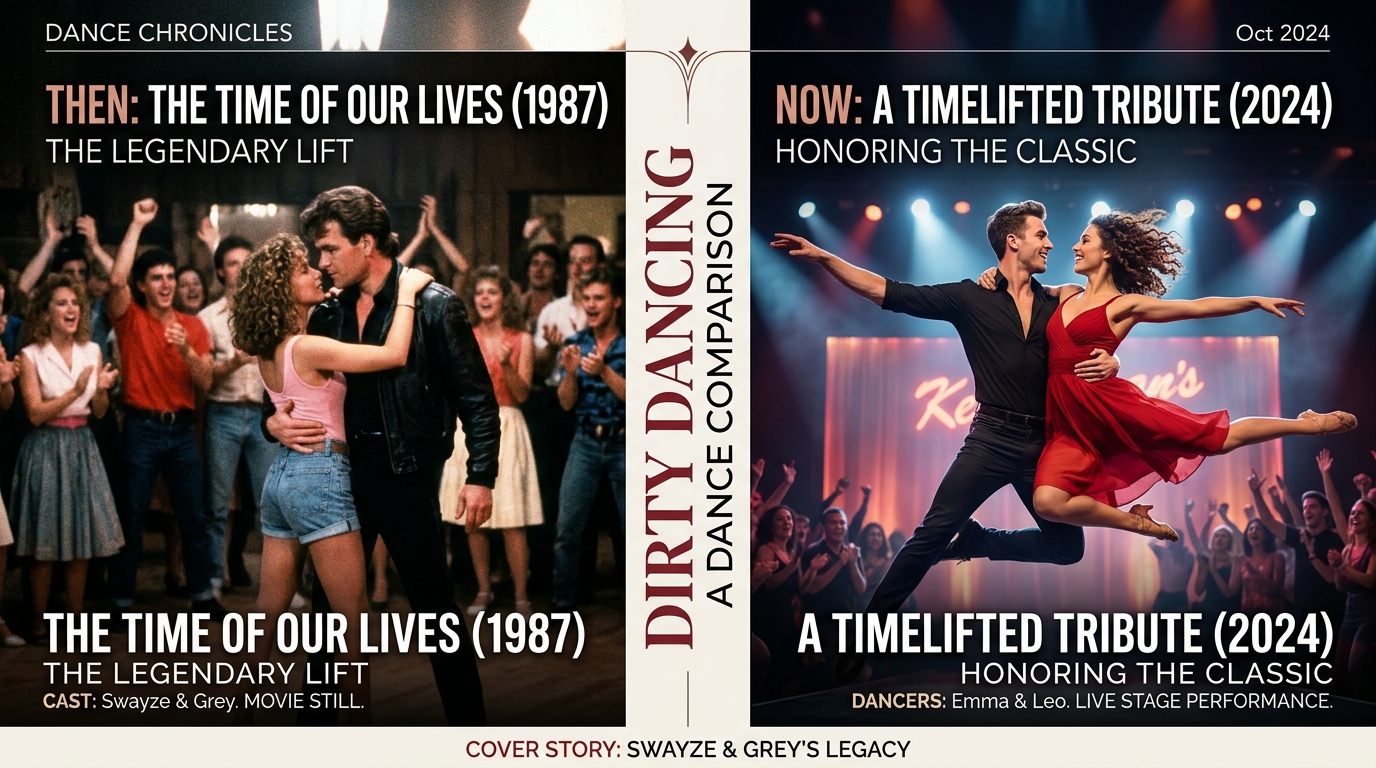
Then vs. Now: Dirty Dancing Legacy
Drag the slider to compare the 1987 film with its lasting impact
 1987
Today
1987
Today
The Chemistry That Captivated Millions
The on-screen chemistry between Patrick Swayze and Jennifer Grey was undeniable—but it wasn't simple. In fact, they had a history that made their connection complicated.
They had met years earlier, when Grey was 19 and Swayze was 29. Swayze was married to Lisa Niemi, and Grey was in a relationship. There was an attraction, but nothing happened. When they were cast together in Dirty Dancing, that history was still there—unspoken but present.
During filming, their relationship was professional but fraught with tension. They argued. They had different approaches to acting—Swayze was method, Grey more intuitive. The famous scene where Johnny and Baby argue in the dance studio wasn't entirely acting; there was real frustration between them.
But that tension became part of what made their chemistry so electric. The push and pull, the moments of connection followed by distance, the gradual building of trust—it all felt real because, in many ways, it was real.
The lift—the iconic moment where Johnny lifts Baby above his head in the lake—was filmed in one take. It wasn't planned to be the final shot of the sequence, but when they nailed it, everyone knew. That was the moment. That was the image that would define the film.
Behind the Scenes: The Making of Magic
The production of Dirty Dancing was marked by challenges, creativity, and moments that have become legendary.
The lake scene was filmed at Mountain Lake Hotel in Virginia, which stood in for Kellerman's Resort. The water was freezing—much colder than the summer setting of the film. Grey and Swayze were shivering between takes, but you'd never know it watching the scene. The chemistry, the intimacy, the joy—it's all there.
The dance sequences were choreographed by Kenny Ortega, who would go on to choreograph High School Musical. He worked closely with the actors, tailoring the routines to their strengths. Swayze's solo dance to "She's Like the Wind" was largely improvised—Swayze just let go, and the result was mesmerizing.
The soundtrack was recorded before filming, unusual for the time. This meant the actors could dance to the actual music that would be in the film, giving the performances a rhythm and energy that matched the songs perfectly. The decision to record the soundtrack first was a risk—it meant the film would have to be edited to match the music—but it paid off.
The budget was so tight that corners had to be cut. The famous watermelon scene, where Baby carries a watermelon to the staff quarters, was filmed in one take because there wasn't money for multiple takes. The intimacy of the film—the small sets, the close camera work—was partly a necessity, but it became a stylistic choice that made the story feel personal and immediate.
💃 Dirty Dancing Trivia
Test your knowledge! Click to reveal surprising facts
Dirty Dancing was made on a budget of just $6 million—a modest sum even for 1987. The film went on to gross over $214 million worldwide, making it one of the most profitable films of all time relative to its budget.
Val Kilmer was the first choice for Johnny, but he turned it down. Other actors considered included Billy Zane and Patrick Dempsey. The role eventually went to Patrick Swayze, who was initially considered "too old" at 34.
In the early 90s, Jennifer Grey underwent a rhinoplasty (nose job) that dramatically changed her appearance. The surgery was so successful that she became virtually unrecognizable, which initially hurt her career. She has since said she regrets the procedure.
Dirty Dancing won only one Oscar: Best Original Song for "(I've Had) The Time of My Life." It was also nominated for Best Original Screenplay, Best Film Editing, and Best Sound. The soundtrack album won a Grammy.
A sequel, Dirty Dancing: Havana Nights, was released in 2004 without the involvement of the original cast or creators. It was a critical and commercial failure. Patrick Swayze and Jennifer Grey both refused to participate, feeling the story was complete.
The Soundtrack That Defined a Generation
If Dirty Dancing had been just a movie, it would have been remembered fondly. But the soundtrack elevated it to something else—a cultural touchstone.
"(I've Had) The Time of My Life," performed by Bill Medley and Jennifer Warnes, became an instant classic. The duet, which plays during the final dance sequence, captured the film's themes of love, growth, and seizing the moment. It won the Oscar for Best Original Song and spent weeks at the top of the charts.
"Hungry Eyes," sung by Eric Carmen, became the anthem of longing and desire. The lyrics—"I've been meaning to tell you / I've got this feeling that won't subside"—perfectly captured Baby's growing feelings for Johnny.
"She's Like the Wind," performed by Patrick Swayze himself, showed another side of the star. Swayze had recorded the song as a demo, but it was so good that it was included on the soundtrack. His gravelly, emotional delivery added depth to Johnny's character.
The soundtrack album spent 18 weeks at number one on the Billboard 200, a record at the time. It sold over 42 million copies worldwide, making it one of the best-selling soundtracks of all time. The music became inseparable from the film—you couldn't hear "The Time of My Life" without thinking of that final lift.
The Legacy: Why We Still Care
More than 35 years later, Dirty Dancing remains beloved. It's in constant rotation on television. It's available on every streaming platform. New generations discover it every year. But why does it endure?
Part of it's the timelessness. The story is about coming of age, about challenging expectations, about finding your voice. These are universal experiences. The setting—1963, on the cusp of the civil rights movement—gives the film historical context, but the emotions are timeless.
Part of it's the chemistry. Patrick Swayze and Jennifer Grey created something rare—a connection that feels authentic, earned, worth investing in. When they dance together, you believe they're falling in love. When they fight, you feel the tension. When they reconcile, you feel the relief.
Part of it's the dancing. The choreography is stunning, but it's also accessible. You watch it and think, "I could do that" (even if you couldn't). The joy of dancing, the freedom of movement, the connection between partners—it's all there, captured beautifully.
And part of it's the message. Dirty Dancing is about believing in someone even when they don't believe in themselves. It's about standing up for what's right, even when it's hard. It's about the transformative power of love—not romantic love, necessarily, but love in all its forms: love between friends, love between mentors and students, love between family members.
The Lives After Dirty Dancing
For Patrick Swayze, Dirty Dancing was the beginning of a remarkable run. The next year, he starred in Road House, which became a cult classic. In 1990, Ghost made him a bona fide movie star—the film was a massive hit, and Swayze's performance as a murdered man trying to communicate with his grieving wife was both funny and heartbreaking.
Swayze continued to work throughout the 90s and 2000s, appearing in films like Point Break (1991), To Wong Foo, Thanks for Everything! Julie Newmar (1995), and Donnie Darko (2001). But in 2008, he was diagnosed with pancreatic cancer. He passed away in September 2009 at age 57.
For Jennifer Grey, the aftermath of Dirty Dancing was more complicated. The film made her a star, but her career didn't follow a straight line. She appeared in films like Bloodhounds of Broadway (1989) and Wind (1992), but the roles didn't capitalize on her Dirty Dancing success.
In the early 90s, Grey made the decision to have a rhinoplasty that dramatically changed her appearance. The surgery was successful aesthetically, but it made her virtually unrecognizable, which hurt her career. For years, she struggled to find work.
But Grey persevered. She appeared in television shows like Friends and Red Oaks. She competed on Dancing with the Stars in 2010, finishing in fifth place—a full circle moment for the actress who had once been the clumsy Baby. She also found fulfillment in writing, publishing her memoir "Out of the Corner" in 2023.
The Dirty Dancing Renaissance
In recent years, Dirty Dancing has experienced a renaissance. A stage musical adaptation opened in 2004 and has been performed worldwide. A 2017 television remake attempted to capture the magic, though most fans agree nothing can replace the original.
The film has been referenced and homaged in countless other works. The lift has been recreated in everything from Friends to Glee. "The Time of My Life" remains a Wedding staple. The film's influence is everywhere.
Perhaps most importantly, new generations continue to discover Dirty Dancing. Teenagers today watch it and see themselves in Baby—the awkwardness, the desire to be seen, the journey toward confidence. The film speaks across generations because its themes are universal.
The Final Word
Dirty Dancing is more than a movie—it's a memory. For those who saw it in 1987, it's a reminder of a summer when anything seemed possible. For those who discovered it later, it's a connection to a different time, a different way of experiencing stories.
The film works because it respects its audience. It doesn't talk down to teenagers. It doesn't simplify the complexities of desire, of class differences, of the choices we make when we're young and think we know everything.
It captures something essential about the human experience: that moment when we realize we're capable of more than anyone thought—including ourselves. That moment when someone believes in us, and through their belief, we start to believe in ourselves.
And that, ultimately, is why we're still dancing.
Dirty Dancing
Patrick Swayze
80s Movies
Classic Cinema
Nostalgia
Published January 5, 2026 by Michelle Torres · 19 min read