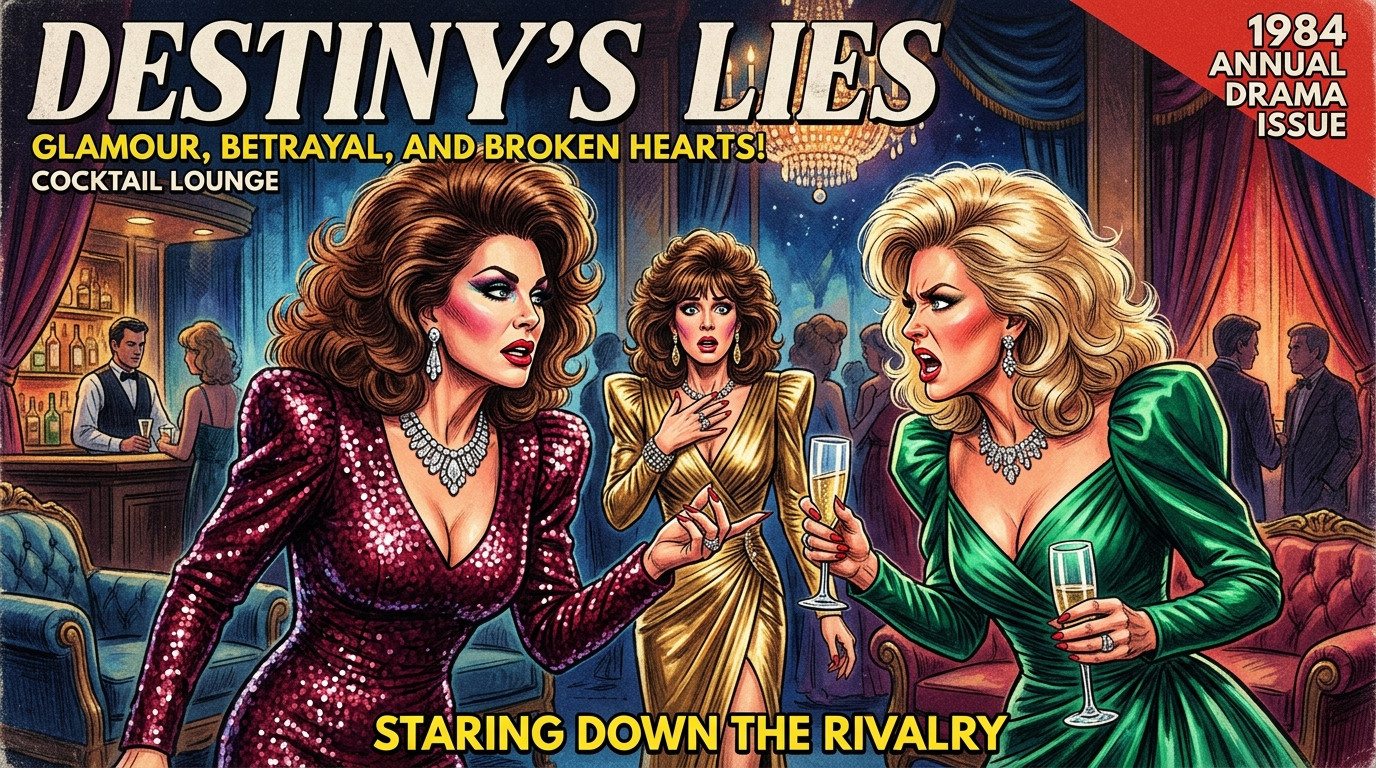
"Who shot J.R.?" For eight months in 1980, that question consumed America. Watergate had nothing on the Ewing family. The 1980s weren't just the golden age of soap operas—they were the decade that invented appointment television.
The Golden Age of Daytime Drama
To understand the 80s soap opera phenomenon, you have to understand what came before. Soap operas had existed since the 1930s, first on radio and then on television. But by the late 1970s, the genre was in decline. Viewership was dropping. Networks were considering cancellation. The soaps were, well, getting a little too soapy.
Then came the 1980s, and everything changed. Producers took risks. Writers pushed boundaries. And suddenly, soap operas weren't just for housewives anymore—they were cultural events. College students gathered in dorms to watch. Office workers set VCRs to record. Presidents made cameo appearances. The soaps had arrived.
What made the 80s different? For one thing, the soaps went primetime. "Dallas" and "Dynasty" proved that nighttime audiences would tune in for the same melodrama that captivated daytime viewers. They brought bigger budgets, bigger stars, and bigger production values. But they kept the essential ingredients: forbidden love, family feuds, shocking betrayals, and characters you loved to hate.
Dallas: The Show That Started It All
"Dallas" premiered in 1978, but it didn't become a phenomenon until its third season—and specifically, until that fateful episode in March 1980. The season finale ended with J.R. Ewing, the oil tycoon everyone loved to hate, being shot by an unseen assailant. The screen went black. America went crazy.
Larry Hagman as J.R. Ewing was the performance of a lifetime. J.R. was everything you shouldn't root for: manipulative, greedy, unfaithful, and utterly ruthless. But Hagman played him with such charm, such wit, such undeniable charisma that you couldn't look away. He was the villain you secretly wanted to win. When he was shot, the country didn't just want to know who did it—they wanted to know if he would survive.
The "Who Shot J.R.?" mystery became a national obsession. T-shirts were printed. Betting pools were organized. News anchors discussed it on evening broadcasts. The resolution, which revealed that J.R.'s sister-in-law Kristin was the shooter, drew 83 million viewers—making it one of the most-watched television episodes in history. "Dallas" had proven that soap operas weren't just daytime filler. They were appointment viewing.
But "Dallas" was about more than just J.R. The show explored themes of family loyalty, ambition, and the corrupting influence of wealth. The Ewing family, with their oil empire and Southfork ranch, represented everything Americans aspired to—and everything they feared. The show asked: What would you do for power? What would you sacrifice for family? How far would you go to protect what's yours?
Dynasty: The Carringtons Reign Supreme
If "Dallas" was about oil money, "Dynasty" was about old money—and new money, and the explosive collision between them. The show premiered in 1981 as ABC's answer to "Dallas," but it quickly developed its own identity and, some would argue, surpassed its inspiration in sheer spectacle.
Joan Collins as Alexis Carrington Colby was the revelation that defined "Dynasty." When Collins joined the cast in season 2, she wasn't just another character—she was a force of nature. Alexis was the ex-wife of billionaire Blake Carrington, returning to claim what she believed was hers. She was glamorous, vindictive, and utterly unstoppable. Collins played her with such relish that Alexis became the show's breakout character.
The rivalry between Alexis and Blake's new wife, Krystle (played by Linda Evans), became the stuff of legend. Their catfights—literally, they would physically fight in swimming pools, mud pits, and ballrooms—were talked about for days. But underneath the spectacle was something deeper: two women fighting for their place in a world that valued men over women, money over everything.
"Dynasty" was famous for its fashion. The shoulder pads alone could have their own museum. The gowns, the jewels, the hair—it was aspirational television at its finest. Women across America wanted to be Alexis. Men wanted to be with her (or at least, they wanted to watch her). The show made fashion as important as plot, and it worked.
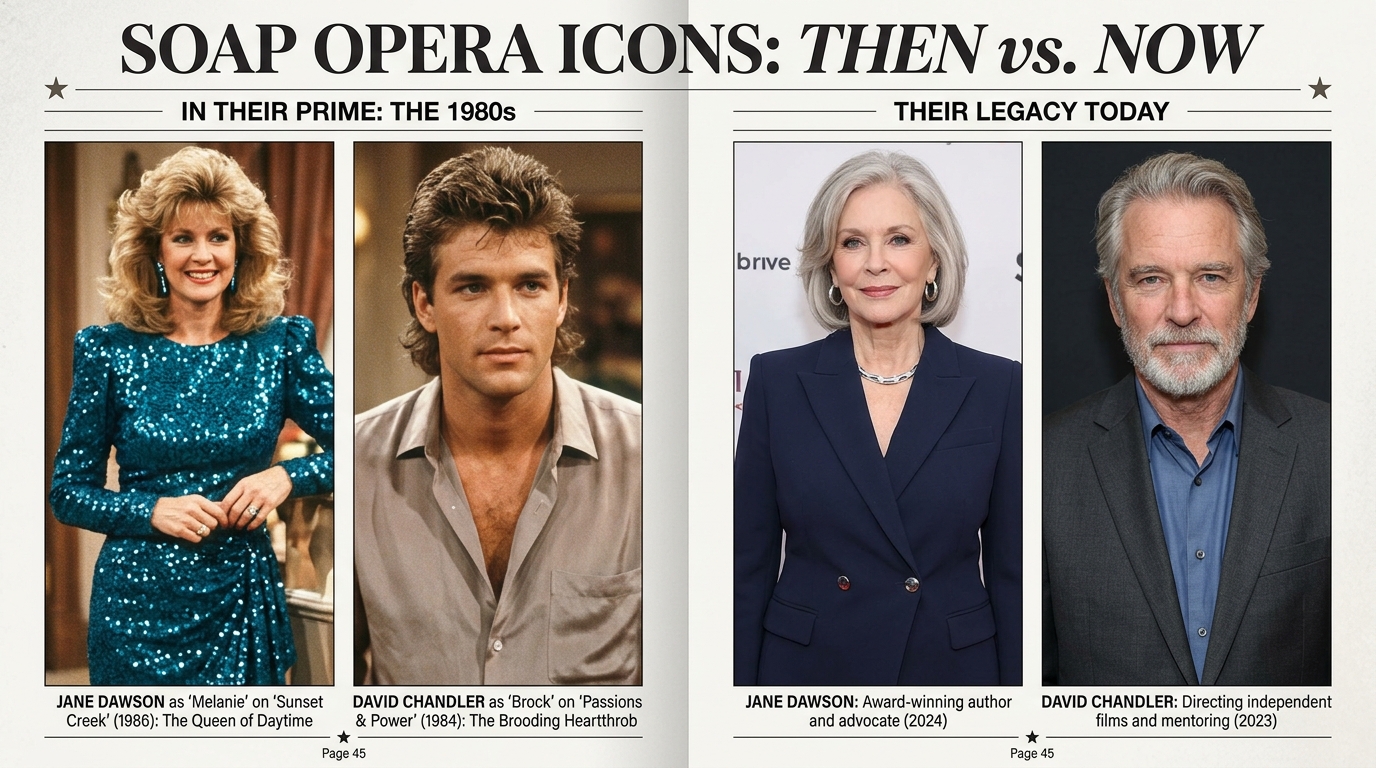
Then vs. Now: Soap Opera Stars
Drag the slider to compare iconic 80s stars with their legacy today
 1985
Today
1985
Today
The Daytime Giants: General Hospital and All My Children
While "Dallas" and "Dynasty" conquered primetime, daytime soaps were having their own renaissance. "General Hospital" and "All My Children" weren't just surviving—they were thriving, reinventing themselves for a new generation.
General Hospital's transformation in the late 70s and early 80s was nothing short of miraculous. The show, which had been struggling in the ratings, introduced the Luke and Laura storyline—a romance so epic it became a cultural phenomenon. Their Wedding in 1981 drew 30 million viewers, more than most primetime shows. They appeared on the cover of Newsweek. They were invited to the White House. For a time, Luke and Laura were bigger than most movie stars.
All My Children, created by the legendary Agnes Nixon, tackled social issues that other shows wouldn't touch. The show featured the first lesbian character on daytime television (Dr. Lynn Carson, played by Donna Pescow). It addressed AIDS, domestic violence, and addiction. These weren't after-school special messages—they were woven into compelling stories about characters viewers cared about.
The Supercouple Phenomenon
The 80s gave us the concept of the "supercouple"—pairs so popular that their romance became the central storyline of entire shows. Luke and Laura started it, but they weren't alone.
On "Days of Our Lives," Bo and Brady (or "Bope," as fans called them) defined the decade. Their on-screen chemistry was electric, but their off-screen romance was even better: actors Peter Reckell and Kristian Alfonso fell in love while playing characters in love. When they married in real life, fans felt like they were part of the fairy tale.
"One Life to Live" gave us Clint and Viki, a couple whose love survived amnesia, multiple personalities, and more than their fair share of tragedy. "The Young and the Restless" introduced Nikki and Victor Newman, whose tumultuous relationship would span decades and multiple marriages.
What made these couples so compelling? Part of it was the actors' chemistry. But it was also the writing. These weren't perfect relationships. They fought. They broke up. They made mistakes. But they always found their way back to each other. In a world where real relationships seemed increasingly fragile, the supercouples offered hope.
🎬 Soap Opera Trivia
Test your knowledge! Click to reveal surprising facts
Kristin Shepard, J.R.'s sister-in-law and former lover, was the shooter. The reveal was so highly anticipated that the episode's title was simply "Who Done It?" The answer shocked viewers who had suspected everyone from J.R.'s wife Sue Ellen to his business rival Cliff Barnes.
"All My Children" holds the record for most Daytime Emmy Awards for Outstanding Drama Series, with 5 wins. Creator Agnes Nixon was known for tackling social issues before they were mainstream, including the first regular lesbian character on daytime TV.
At the height of "Dynasty's" popularity, Joan Collins was earning an incredible $60,000 per episode—making her one of the highest-paid actresses on television. Her salary negotiations were legendary, and she always got what she wanted.
Ronald Reagan made a cameo appearance on "Dynasty" in 1985, appearing as himself at a charity ball. It was unprecedented for a sitting president to appear on a soap opera, demonstrating just how culturally significant these shows had become.
"General Hospital" is the longest-running American soap opera still in production, with over 14,000 episodes aired since 1963. The Luke and Laura storyline alone spanned more than 1,000 episodes and defined the show for an entire decade.
Behind the Scenes: The Real Drama
What happened on screen was dramatic, but what happened behind the scenes was often even more so. Soap operas filmed at a breakneck pace—sometimes completing an entire episode in a single day. Actors memorized pages of dialogue daily. Mistakes couldn't be easily fixed—there was no time for multiple takes.
The pressure was intense. Many actors struggled with the workload. Some turned to substances to cope. Others left the business entirely, burned out by the relentless schedule. But for those who stayed, the bonds formed were deep and lasting.
Off-screen romances were as common as on-screen ones. Actors who played lovers often fell in love in real life. Sometimes it worked out—like "Days of Our Lives" stars Peter Reckell and Kristian Alfonso, who married and had children together. Other times, the romance ended as dramatically as the storylines.
Feuds between actors could be legendary. Joan Collins and Linda Evans reportedly had a tense relationship off-screen, though both denied it. Larry Hagman was known for his practical jokes on the set of "Dallas," sometimes driving his co-stars to distraction. But when the cameras rolled, everyone was professional.
The Fashion That Defined an Era
You can't talk about 80s soap operas without talking about the fashion. The shoulder pads alone deserve their own documentary. But beyond the exaggerated silhouettes, there was real style happening.
Dynasty was the fashion leader. Alexis Carrington's gowns were designed by Nolan Miller, who became famous for creating looks that were simultaneously over-the-top and somehow believable. Every woman watching wanted her closet. Every man watching wanted her—or at least, wanted to be with someone who dressed like her.
Dallas had a different aesthetic—Texas oil money meets Western wear. J.R. Ewing's cowboy boots and Stetson became iconic. Sue Ellen's evolution from repressed wife to independent woman was reflected in her wardrobe, which went from conservative dresses to power suits.
Daytime soaps had smaller budgets but no less style. "General Hospital's" supercouples set trends with their casual looks—Luke's leather jacket, Laura's flowing dresses. "All My Children" reflected the changing times, with characters transitioning from 70s bohemian to 80s power dressing.
The Cultural Impact: Why We Still Care
Why do 80s soap operas still matter? Part of it's nostalgia—watching these shows is like stepping into a time machine. But there's more to it than that.
These shows addressed real issues. AIDS was a storyline on "All My Children" before most primetime shows would touch it. Domestic violence was explored on "General Hospital" with nuance and sensitivity. "Dynasty" tackled class warfare and gender roles, even if it did so amid catfights and shoulder pads.
The characters were complex. Yes, they were melodramatic. Yes, the situations were often ridiculous. But underneath it all, these were people dealing with real emotions: love, loss, ambition, betrayal. We saw ourselves in them, even as we laughed at their excesses.
And the storytelling was masterful. Soap operas taught television how to do long-form narrative. They proved that viewers would invest in stories that unfolded over months and years. Every serialized drama that exists today—from "Breaking Bad" to "Game of Thrones"—owes something to the soap operas of the 80s.
Where Are They Now?
The golden age of soap operas eventually ended. Viewership declined as cable television and then the internet provided more options. Several long-running soaps were cancelled in the 2000s and 2010s. But the stars who defined the era have continued their careers.
Joan Collins became a Dame, authored books, and continued acting well into her 80s. She's remained a cultural icon, appearing on everything from "The Simpsons" to "American Horror Story." Her autobiography, published in 1997, revealed the secrets behind the glamour.
Linda Evans largely retired from acting, moving to Washington state and embracing a quieter life. She's made occasional appearances, but she's said that she left Hollywood behind without regrets.
Larry Hagman continued acting until his death in 2012, reprising J.R. Ewing for a "Dallas" reboot in 2012. His final performance was as fitting as his first—J.R. died as he lived, on his own terms, surrounded by family (and enemies).
Victoria Principal (Pamela Ewing) left acting to focus on business, launching a successful skincare line. She's made occasional returns to television but has largely stayed out of the spotlight.
The Final Word
The 80s soap operas were more than just guilty pleasures. They were cultural touchstones, shared experiences that brought millions of people together. We watched them together. We talked about them together. We lived through them together.
In an era before streaming, before social media, before 24-hour news cycles, these shows gave us something to talk about. They gave us characters to love, villains to hate, and couples to root for. They made us feel something.
And isn't that what great storytelling is supposed to do?
80s TV
Soap Operas
Dallas
Dynasty
Nostalgia
Published January 12, 2026 by Victoria Sterling · 18 min read